
Fragrance Oils for Candle Making in UAE: Types, Selection Criteria, and 2026 Market Guide
Fragrance oils for candle making in UAE vary by scent family, wax compatibility, flashpoint, and IFRA compliance status. Candle makers use fragrance oils rather than essential oils in most applications because fragrance oils produce stronger hot throw, greater scent stability at high temperatures, and more consistent performance across wax types. This guide covers the technical criteria for selecting fragrance oils, 7 scent categories used in UAE candle production, and current regional market data.
What Are Fragrance Oils for Candle Making?
Fragrance oils for candle making are aromatic compounds — synthetic, natural, or blended — formulated to withstand candle-making temperatures and release scent during cold and hot burn phases. They differ from essential oils in molecular stability and scent performance at high heat.
Essential oils are 100% botanical extracts distilled or cold-pressed from plants. Fragrance oils combine natural isolates with synthetic aroma chemicals to achieve consistent performance, wider scent variety, and more stable throw across wax types.
A candle-grade fragrance oil must meet 3 minimum technical requirements:
- Flashpoint at or above 65°C to prevent ignition during the mixing process
- Fragrance load compatibility between 6% and 12% depending on wax type
- IFRA compliance covering indoor air exposure and, where applicable, skin contact
How Does Fragrance Load Affect Candle Performance in UAE Conditions?
Fragrance load is the percentage of fragrance oil by weight added to melted wax. In UAE conditions — where ambient temperatures regularly exceed 35°C — fragrance load directly affects scent throw strength, wax adhesion, and candle surface finish.
|
Wax Type |
Recommended Fragrance Load |
|
Soy wax (single pour) |
6–8% |
|
Coconut-soy blend |
8–10% |
|
Paraffin wax |
6–10% |
|
Luxury blended wax |
Up to 12% |
Exceeding the recommended fragrance load causes fragrance oil to pool on the candle surface, produces uneven burn tunnels, and increases the risk of flashpoint safety incidents. Under-loading produces weak hot throw. A 2023 candle industry study found that 68% of consumer complaints about candle scent performance were linked to incorrect fragrance load rather than fragrance quality.
In UAE storage environments, high ambient temperatures accelerate fragrance evaporation from unsealed candles. Candle makers operating in UAE should test fragrance load at the lower end of the recommended range first, then increase incrementally based on scent throw results.
What Is Flashpoint and Why Does It Matter for UAE Candle Makers?
Flashpoint is the minimum temperature at which a fragrance oil produces enough vapour to ignite momentarily when exposed to an open flame. Candle-grade fragrance oils require a flashpoint above 65°C. For UAE production environments — where storage and workshop temperatures are higher than in temperate climates — most professional candle makers source oils with flashpoints above 70°C.
A fragrance oil with a flashpoint below 65°C must not be added to wax at or above that temperature. Doing so creates a fire risk during production. UAE Civil Defense standards classify any flammable liquid below 60°C as a hazardous substance requiring special storage, handling, and facility documentation.
Every fragrance oil supplier should provide a Safety Data Sheet (SDS) confirming the flashpoint value, storage conditions, and handling classification. This document is a baseline requirement before purchasing any fragrance oil for commercial candle production.
What Does IFRA Compliance Mean for Fragrance Oils Used in UAE Candles?
IFRA (International Fragrance Association) compliance means a fragrance oil has been formulated within the usage limits defined in the IFRA Standards for each application category. For candle making, the relevant category is Category 12, which covers products with open flame and direct air exposure.
IFRA compliance matters for UAE candle brands for 3 reasons:
- Commercial candle products sold in UAE retail require allergen disclosure above threshold concentrations defined by IFRA
- Export to EU and UK markets legally requires full IFRA compliance documentation per EU Cosmetic Regulation 1223/2009
- IFRA-compliant fragrance oils carry documented safety assessments that protect brands in the event of consumer complaints or regulatory checks
A fragrance oil without an IFRA compliance certificate cannot be verified as safe for commercial candle production. When sourcing oils, always request the IFRA certificate alongside the SDS before placing a production order.
What Are the 7 Fragrance Oil Categories That Perform in UAE Candle Markets?
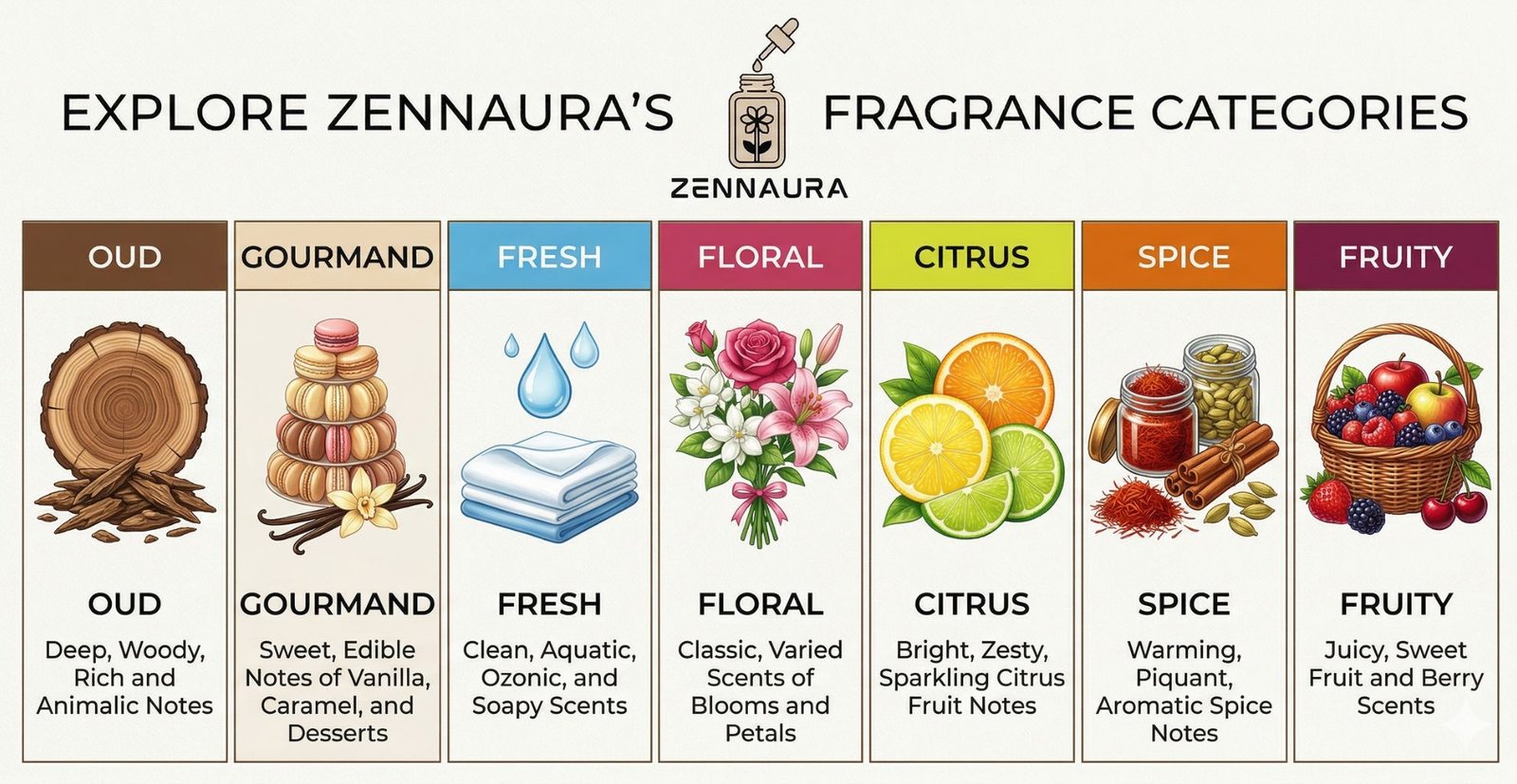
The UAE candle market divides into distinct scent preferences shaped by regional culture, climate, and consumer demographics. These 7 categories account for the majority of fragrance oil demand in UAE candle production:
- Oud and Arabic Resinous Blends
Oud fragrance oils combine resinous, woody, and smoky notes derived from agarwood (Aquilaria species). In the UAE, oud-based candle fragrances carry strong cultural familiarity, making them the highest-converting scent category for gifting and home luxury applications. Common compound notes include amber, musk, sandalwood, and rose layered over an oud base. These oils have high molecular density and perform well at fragrance loads of 7–9% in paraffin and blended wax.
- Gourmand Blends
Gourmand fragrance oils use vanilla, caramel, coffee, and chocolate note profiles. Vanilla is the top-selling single-note fragrance oil category globally. In the UAE, gourmand blends perform strongly in modern home and gifting retail because they create emotional comfort associations. They are compatible with soy wax at 7–8% fragrance load and produce strong cold throw in enclosed spaces.
- Fresh and Clean Aquatic Scents
Fresh fragrance oils use ocean, linen, citrus, and light musk profiles. They are in demand for hotel amenity candles, corporate gifting products, and modern minimalist home brands. These oils have lower molecular density than resinous blends and perform at 6–7% fragrance load in soy wax. Hot throw is moderate; cold throw is strong in enclosed spaces.
- Floral Single-Note and Bouquet Oils
Floral fragrance oils use jasmine, rose, lavender, and ylang ylang as primary notes. Lavender is the most widely used calming fragrance oil in candle applications globally, with consistent demand across wellness retail and spa environments. Rose-based blends sell strongly in UAE gifting markets due to cultural association with premium personal care products.
- Citrus and Herbal Blends
Citrus fragrance oils — using lemon, bergamot, lemongrass, and grapefruit notes — produce bright, uplifting scent profiles with moderate hot throw. They perform best in coconut-soy or blended wax at 7–9% fragrance load. In UAE, citrus blends are primarily used in office, hotel lobby, and commercial candle products where a neutral, non-polarising scent is preferred.
- Spice and Oriental Warm Blends
Spice-based fragrance oils combine cinnamon, cardamom, clove, saffron, and pepper notes. These are used in seasonal candles and premium gifting collections. In the UAE, saffron-based blends command higher retail prices due to cultural familiarity with the ingredient in luxury products. These oils are high-density and require careful flashpoint verification as some spice compounds lower the overall flashpoint of a blend.
- Fruity and Tropical Blends
Fruity fragrance oils use mango, pineapple, strawberry, and berry note profiles at moderate fragrance loads. They are primarily used in lifestyle and gifting candle brands targeting 18–35-year-old UAE consumers. These oils produce strong cold throw and pair visually with pastel-coloured candle aesthetics popular on UAE social commerce platforms. Hot throw is moderate at standard soy wax fragrance loads.
How Do UAE Candle Makers Evaluate a Fragrance Oil Supplier?
UAE candle makers producing for retail or export should evaluate fragrance oil suppliers on 5 technical documents before placing a commercial order:
- GC (Gas Chromatography) test report confirming composition and purity of the oil
- IFRA compliance certificate covering the candle application category
- Safety Data Sheet (SDS) with confirmed flashpoint value and storage classification
- Minimum fragrance load recommendation specific to the target wax type
- Allergen declaration listing compounds present above 0.01% concentration
Candle brands producing for EU or UK export markets legally require all 5 documents before production begins. Domestic UAE brands require at minimum the SDS and IFRA certificate for commercial liability protection and retail listing compliance.
Requesting these documents before purchase is standard industry practice. Any supplier unable to provide them should not be used for commercial candle production.
What Does UAE Candle Market Data Show About Fragrance Oil Demand in 2026?
The UAE luxury candle market was valued at approximately USD 180 million in 2024, with compound annual growth projected at 8.4% through 2029 (Mordor Intelligence, 2024). Key demand drivers include:
- Rising demand for home fragrance products in UAE households following post-pandemic interior wellness trends
- Growth of independent candle brands in Dubai and Abu Dhabi targeting gifting retail
- Increasing B2B demand from the hospitality sector for custom-scented amenity candles
- Export potential for UAE-made candles to GCC, UK, and EU premium lifestyle markets
Scent category demand in UAE candle production breaks down as follows: oud-based fragrance oils account for approximately 35% of purchases among UAE candle makers. Vanilla and gourmand blends account for 22%. Fresh and clean scents account for 18%. Floral, fruity, spice, and citrus categories make up the remaining 25%.
Seasonal and limited-edition scent launches are used by UAE candle brands to drive social media engagement, but core bestselling scents — typically oud, vanilla, and fresh linen — generate the majority of recurring revenue for established brands.
Frequently Asked Questions About Fragrance Oils for Candle Making in UAE
What is the difference between fragrance oil and essential oil for candle making?
Fragrance oils are synthetic or blended aromatic compounds formulated for high-temperature stability and consistent scent throw. Essential oils are 100% botanical extracts. Fragrance oils are used in most candle production because they produce stronger, more stable hot throw at lower cost per kilogram than essential oils.
What fragrance load should I use for soy wax candles in UAE?
Soy wax candles in UAE should use a fragrance load of 6–8% by weight. High ambient storage temperatures in the UAE can affect scent throw, so testing at 7% is the standard starting point for UAE production before adjusting up or down based on cold and hot throw results.
Do I need IFRA certification if I sell candles commercially in UAE?
Yes. Commercial candle brands in UAE require IFRA-compliant fragrance oils for product liability protection and to meet retail listing requirements. Export to EU and UK markets legally requires full IFRA compliance documentation under EU Cosmetic Regulation 1223/2009.
Can I use the same fragrance oil for both candles and diffusers?
No. Candle-grade fragrance oils are formulated for wax binding and high-temperature performance. Diffuser fragrance oils use different carrier bases and dilution ratios. Using a diffuser oil in a candle can create flashpoint safety issues. Always source candle-specific fragrance oils for candle production.
Which fragrance oil scents sell best in UAE candle retail?
Oud-based blends, vanilla, and fresh linen are the three highest-converting scent categories in UAE candle retail. Oud dominates gifting and luxury home segments. Vanilla sells consistently across consumer demographics. Fresh linen and clean scents are growing in hotel, office, and minimalist home channels.
Choosing Fragrance Oils for Candle Making in UAE Requires Technical and Market Knowledge
Fragrance oil selection for UAE candle production combines technical criteria — flashpoint, fragrance load, IFRA compliance, and wax compatibility — with an understanding of local scent preferences. The 7 fragrance categories that perform in UAE markets range from oud and Arabic resinous blends to fresh, floral, and gourmand profiles, each with specific wax and formulation requirements.
Before sourcing from any supplier, request the 5 key documents: GC report, IFRA certificate, SDS, fragrance load guidance, and allergen declaration. These documents protect your brand legally and ensure your candles perform consistently at production scale.
Looking for Fragrance Oils in UAE?
Zennaura supplies IFRA-certified, GC-tested fragrance oils purpose-built for candle making — available in 30ml to 1-litre quantities with full safety documentation.
Browse fragrance oils for candle making → zennaura.com/product-category/fragrance-oils